Written By Vanessa Schaefer and Dr. Eli Typhina
The use of plastics and single-use items in the US has skyrocketed. For example, Americans purchase 50 billion water bottles every year, which not only clog landfills, but also leach toxins into soil and groundwater upon disposal and, during manufacturing, release toxins associated with respiratory diseases and cancers (Earthday, 2022; Derhab & Elkhwesky 2023). Researchers estimate that while 67% of waste is recycled in residential settings, only 39% undergoes recycling in workplace environments (Whitemarsh et al., 2018), highlighting a significant opportunity for improving recycling habits in workplaces.
My name is Vanessa Schaefer. I am a recent graduate of the Environmental Science program and with this discrepancy in mind I decided to develop an innovation to reduce single use kitchen waste items in a national architecture, engineering, and construction company called Mead and Hunt. I chose this company because their 2022 ESG report states a 1 year goal of “Eliminating single-use plastic where reusable options exist (e.g., Keurig cups, water bottles, cutlery)” (Mead & Hunt, 2022). Mead and Hunt (image of office below) provides services to industries in architecture, food/beverage processing, transportation, and water infrastructure in nearly all 50 states; thus, offering a diverse office environment to explore steps to reduce office waste. I also chose this organization because it enabled me to build on the relationships and knowledge I had gained through a previous internship with them.
In Dr. Eli Typhina’s Environmental Behavior Change course (ES495), I conducted research and looked at behavioral theories that led me to prototype an innovation that enables Mead and Hunt employees to use reusable kitchen items instead of single-use alternatives and, thus, reduce overall waste produced in offices nationwide. The prototype included 4 parts: a course, an employee event, a goodie-bag with kitchen signage, and activities to inspire continued participation.
Image: Mead and Hunt office

Drawing from Behavioral Theories
To create this innovation, I conducted 5 interviews, reviewed 15 scholarly, popular press, and company sources, as well as explored multiple behavioral theories. In this research, I found the behavioral concept of social norms appearing in multiple instances. Keizer and Schultz (2018) explain norms as behaviors an individual sees others doing that they mimic because they perceive the behaviors as the normal way to behave in that setting. For example, when experimenters (posing as participants) chose the wrong line length in a line-matching experiment, real participants followed suit 75% of the time, despite the visual mismatch (Asch, 1951).
In literature on the topic, norms strongly influenced participants’ intent to participate in waste reduction and recycling behaviors, whether on vacation or in the office (Han et al., 2018; Whitemarsh et al., 2018). In my interviews, one participant explained sustainability as a core company value and the need to demonstrate that to clients. Thus, reducing waste in an office can establish a sustainability focused brand and provide opportunities to publicly demonstrate environmental awareness and ethical responsibility to potential clients, employees, and the community (Allé designs, 2023).
In my interviews with employees, I also noticed how attitudes towards a behavior, combined with norms and perceived behavioral control, would inform intentions and, ultimately, the behavior of employees to reduce waste in the office. The Theory of Planned Behavior (Klockner, 2015), describes this combination of behavioral elements as a way to predict and alter deliberate behaviors, with the strength of someone’s intentions directly influencing the probability of participating in a behavior (Steg & Nordlud, 2018). Research on recycling in offices showed how attitudes (for or against recycling), norms (whether they saw others recycling), and perceived behavioral control (whether they felt it was easy to do) directly correlated with their behavior to recycle (Whitemarsh et al., 2018). In my interviews with Mead and Hunt employees, they indicated negative attitudes towards waste and positive attitudes towards waste reduction. Thus, I decided the innovation needed to emphasize norms by increasing the number of employees participating in waste reduction measures and increasing perceived behavioral control by making it easier to do so.
In order to create a highly effective prototype innovation, I explored similar innovations, one of which included the Duebest Complete Sustainable Gift Set. The set includes a full size and compact wooden cutlery set, a glass straw set, a silicone lid set, cleaning supplies, along with a reusable mask and bag. Owning this set increases the perceived behavioral control of its users to avoid disposable items because it provides reusable items in a convenient bag with cleaning supplies. I also looked at multiple signs and activities to increase norms related to reusable items to inform the design of my innovation.
From this work, I identified a chain of influence between employees, innovation components, and their behavior at work (see diagram below). The components include a training, event, and goodie bag with signs to establish a new official protocol (norms) and increase their ability to avoid disposables (perceived behavioral control) at Mead and Hunt.
Image: Chain of Influence Diagram

Waste Reduction Prototype
To ensure employees found my innovation components desirable to engage with, I first identified their demographics. According to Mead and Hunt’s 2022 ESG Report (2023), employees are Gen X or Millennial, Caucasian, males, and located in urban/semi-urban areas. Interviewees mentioned the importance of improving waste reduction efforts in the south/southeast locations, while the northwest location performed exceptionally well in this area. Additionally, most employees held a college degree, which research shows correlates with higher recycling rates than those without degrees (Whitemarsh et al. 2018). Thus, I made sure the innovation included imagery of the target audience and would be accessible to a diversity of employees.
My innovation included four components. The first, an event called Fun Mug Monday, would enable employees to decorate their own office mugs and receive a complimentary goodie bag of reusable items to replace typical single-use items. In order to attend the event, employees must watch a recorded training video and respond with related ideas and insights twice in a discussion forum. The event can increase perceived behavioral control by ensuring every employee has their own customized mug, reusable materials, and cleaning items, as well as social norms built during the event and on the training forum (Klöckner, 2015; Steg and Nordlund, 2018). The image below, a mock-up of the event flier, enables each office to customize the flier/event and post it around the office and via email. After the event, photos of employees painting their mugs can be used on signs around the office to further increase social norms related to reducing waste.
Image: Fun Mug Monday Poster Mock-up

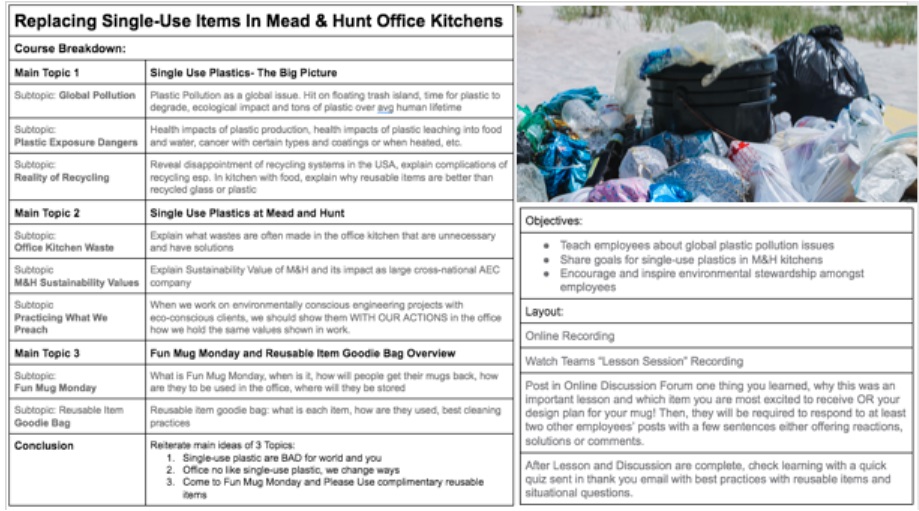
The second component of my innovation, a training session, will include an educational component discussing single use plastics challenges and how to reduce them both globally and at Mead and Hunt. The training session will also cover the Fun Mug Monday event, the reusable goodie bag (as shown in course outline below), and conclude with a comprehension-check quiz. After completing the online videos, accessible via the company’s onboarding software, employees would then post to the discussion forum 1 thing that they learned. Once employees post to the discussion forum, they will receive a confirmation email of course completion. This process will establish norms (through peer posts), eliminate knowledge discrepancies across regions and ages, and set clear expectations as to how waste reduction behavior impacts the company’s image (Keizer & Schultz, 2018; Klöckner, 2015; Steg & Nordlund, 2018).
Image: Training Content Mock-Up
The third component, the Reusable item Goodie Bag, will consist of a canvas tote bag, informational pamphlet, cleaning tools, and reusable straws, cutlery, K-cup, water bottle, and travel mug (as shown in image below). The pamphlet will reiterate the online training takeaways, Mead and Hunts sustainability values, and best practices for cleaning reusable items. One interviewee noted that communal mugs were dirty and hard to find and, thus, the Goodie Bag increases perceived behavioral control by ensuring all employees have access to reusable items they can use in the kitchen (Klöckner, 2015; Steg & Nordlund, 2018). To counter the drawback of the time it takes to wash reusable items, the bag includes cleaning tools and dishwasher safe items (Garlick, 2016). Each employee who successfully watches the training, as well as participates in the online discussion, will receive their Reusable item Goodie Bag at the Fun Mug Monday Event.
Image: Good Bag Mock-Up

The fourth component of the innovation is a kitchen office sign with images from the Fun Mug Monday event that reminds employees of the importance of reusable item use for the benefit of company culture and the planet. With images of smiling employees using their mugs, the sign establishes reusable item use as a norm of the office (McKenzie-Mohr 2011). Additionally, based on the theory of behavior-setting the kitchen will have open shelving that makes it easy to see and access mugs (Kopec 2018). This helps employees overcome the challenge of finding mugs as mentioned by several interviewees and, thus, increase perceived control to use mugs.
Image: Kitchen Sign & Layout Mock-Up

Moving Forward
This innovation could decrease the overall amount of waste created in Mead and Hunt Offices by eliminating the need for single-use kitchen items such as plastic water bottles, styrofoam coffee cups, and plastic cutlery. Taking the estimated 156 water bottles used per person per year and expanding that to the aforementioned items, one office of 20 employees can prevent the waste of 3,120 disposable items per year (Earthday, 2022). The four components of my proposed innovation could decrease use of single-use items in Mead and Hunt Offices, as well as other offices experiencing the same challenge, through employee education and activities that strengthen waste-reduction values and provide the necessary resources to do so.
In the future, I plan to use behavioral theories and methods to create impactful strategies for fostering sustainable change. Currently, Mead and Hunt associates plan to use this project to inspire new programming across their offices nationwide. To learn more about me or contact me with questions about this project, please reach out through my LinkedIn!
Image: Vanessa Schaefer

References
Allé Designs (2023). 4 Benefits of Reducing Waste in the Workplace. https://www.alleofficesolutions.com/blog/4-benefits-of-reducing-waste-in-the-workplace/
Asch, S. E. (1951). Effects of group pressure upon the modification and distortion of judgments. In H. Guetzkow (Ed.), Groups, leadership and men; research in human relations (pp. 177–190). Carnegie Press. https://psycnet.apa.org/record/1952-00803-001
Derhab, N., & Elkhwesky, Z. (2023). A systematic and critical review of waste management in micro, small and medium sized enterprises: Future directions for theory and practice. Environmental Science and Pollution Research International, 30(6), 13920-13944. https://doi.org/10.1007/s11356-022-24742-7
Earthday (2022, March 29). Fact Sheet: Single Use Plastics. Green Cities. https://www.earthday.org/fact-sheet-single-use-plastics/
Garlick, K. (2016, January 11). Can we get rid of our plastic forks? Alternate solutions to our plastic problem in the cafeteria. https://hhsepitaph.com/3800/opinion/the-garlick-press-can-we-get-rid-of-our-plastic-forks/#:~:text=Reusable%20utensils%20do%20have%20drawbacks,leave%20them%20in%20the%20quad.
Han, H., Yu, J., Kim, H. C., & Kim, W. (2018). Impact of social/personal norms and willingness to sacrifice on young vacationers’ pro-environmental intentions for waste reduction and recycling. Journal of Sustainable Tourism, 26(12), 2117-2133. https://doi.org/10.1080/09669582.2018.1538229
Klöckner, C. A. (2015). The psychology of pro-environmental communication: Beyond standard information strategies. (pp. 70-75). London: Palgrave Macmillan.
Kopec, D. A. (2018). Environmental Psychology for Design. New York: Bloomsbury Publishing Inc. https://drive.google.com/file/d/12r2mCSMLqU5vQWQb6Asybgg0hD3D6nO2/view?usp=sharing
McKenzie-Mohr, D. (2011). Fostering sustainable behavior: An introduction to community-based social marketing (pp. 111-120). Gabriola Island, BC: New society publishers.
Mead and Hunt (2023, April 1). 2022 ESG REPORT. https://meadhunt.com/client/ESG/ESGReport_April2023_Web.pdf
Steg, L & Nordlund, A. (2018). Theories to explain environmental behaviour. In L. Steg & J. de Groot (Eds.), Environmental psychology: An introduction (pp. 218 – 225). Hoboken, NJ: Wiley-Blackwell.
Whitemarsh, L., Haggar, P., & Thomas, M. (2018). Waste Reduction Behaviors at Home, at Work, and on Holiday: What Influences Behavioral Consistency Across Contexts? Frontiers in Psychology, 9. https://doi.org/10.3389/fpsyg.2018.02447