Written By Tatiana Luhia and Dr. Eli Typhina
Imagine the Statue of Liberty filled more than 3 times over with trash! That’s how much litter, 14.6 million pounds, the North Carolina Department of Transportation, local governments, and nonprofit organizations removed from North Carolina in 2023 (Duke, 2024). Litter removal cost our state $56.3 million to remove, pointing to a real need for research-based interventions.
My name is Tatiana Luhia, and I am an Environmental Sciences major with a minor in Sustainability Technology Management. I worked with researcher Dr. Eli Typhina on a Sea Grant project aimed at going beyond clean-ups to finding ways to prevent littering. The project focuses on litter in the Marsh Creek waterway (in north east Raleigh) – gathering a baseline understanding of litter and its impact by cataloging trash and collecting water samples, as well as conducting behavioral studies to understand motivations and barriers to proper trash disposal. My role involved reviewing academic and popular press publications, along with existing littering solutions, to understand design, language, and locations for placing interventions. I also assisted with developing protocols and analyzing data collection through observations, interviews, and video footage of littering sites.
As I reviewed existing interventions, I found TetraBin, an interactive bin that gamifies the act of waste disposal by transforming trash bins into a Tetris game (see image). Essentially, as people place litter in the bin, the game activates a digital display showing falling Tetris blocks that correspond to the user’s action. Each piece of trash triggers a new game piece, allowing users to play Tetris in real-time while properly disposing of waste. This design creates immediate positive reinforcement, making the act of throwing away trash an engaging, rewarding experience. Creators documented how the gamified bin effectively captured public attention and increased engagement in proper trash disposal, particularly among younger audiences (see video: TetraBin video).
Image: (TetraBin, 2016)

Game Theory effectively explains TetraBin’s success by transforming routine waste disposal into an engaging experience that naturally motivates environmentally friendly behavior. This theoretical approach suggests that incorporating game-like elements into everyday activities can transform routine behaviors into engaging experiences (Berengueres et al, 2013). Through gamification, we can incorporate non-game systems into games to improve user engagement with desired behaviors. For our project, this means creating trash cans that provide immediate feedback or rewards when used properly, making waste disposal more engaging and satisfying. For example, using color changes and sound effects that “reward” proper waste disposal.
Another interesting theory we found during our research focused on the influence of eye images on human behavior. Specifically, eyes on posters can reduce littering up to 50% due to their ability to create a sense of being watch that, in turn, makes viewers more likely to align to expected social norms, such as disposing of their litter properly (de Kort et al., 2008; Ernest-Jones et al., 2011). For our project, this could mean integrating images of eyes in posters or gamified displays to encourage accountability in public spaces.
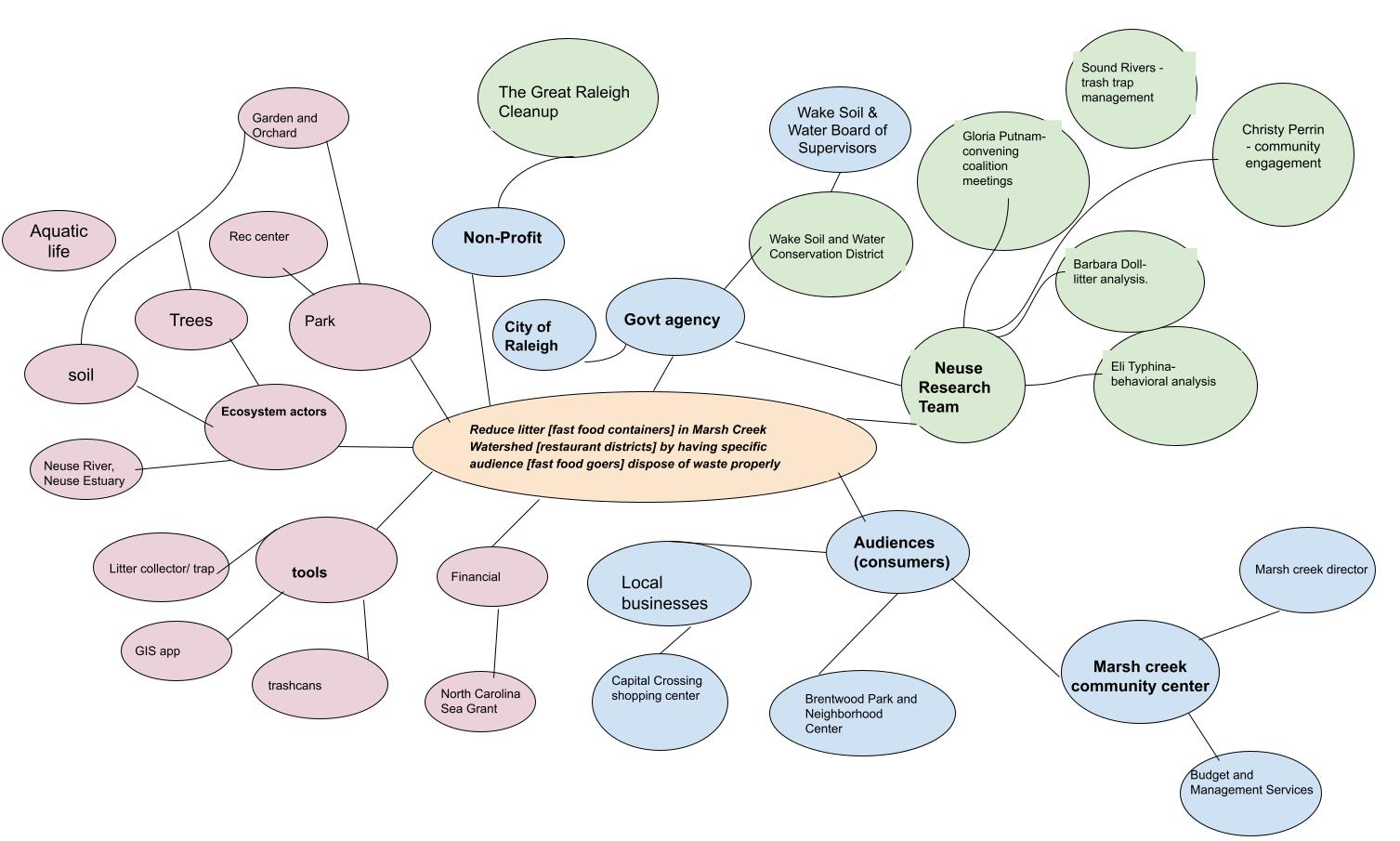
During my internship, I also created an actor tracing diagram to visually map the complex network of human and nonhuman actors influencing littering behavior in the research area (see image below). By identifying key actors such as residents, waste management systems, signage, and environmental organizations, we can reframe the issue of littering from a simple matter of personal responsibility to one driven by interconnected systems (Typhina, 2024). This mapping exercise helped our team clarify actors’ influence, highlight behavior-change opportunities, and combine analytical thinking with creative processes to gain new insights on potential solutions.
Actor Tracing Diagram
Through this internship, I gained valuable insights into psychological patterns behind littering and learned how design elements directly influence human behavior. I appreciate Dr. Typhina’s expertise in sustainable behavior and behavioral interventions, which guided our approach and strengthened my critical thinking skills. Moving forward, I plan to apply these research methods, data analysis techniques, and creative intervention strategies to develop innovative solutions for environmental challenges. I will continue working with Dr. Typhina on this research this summer, collecting data and developing prototypes.
Photo: Tatiana Luhia

References
Berengueres, J., Alsuwairi, F., Zaki, N., & Ng, T. (2013, March). Gamification of a recycle bin with emoticons. In 2013 8th ACM/IEEE International Conference on Human-Robot Interaction (pp. 83-84). IEEE. http://doi.org/10.1109/HRI.2013.6483512
De Kort, Y. A., McCalley, L. T., & Midden, C. J. (2008). Persuasive trash cans activation of littering norms by design. Environment and Behavior, 40, 870–891. https://doi.org/10.1177/0013916507311035
Duke University Environmental Law and Policy Clinic. (2024). The Cost of Litter in North Carolina. https://law.duke.edu/sites/default/files/clinics/environmental/Cost_of_Litter_in_NC.pdf
Ernest-Jones, M., Nettle, D., & Bateson, M. (2011). Effects of eye images on everyday cooperative behavior: a field experiment. Evolution and Human Behavior, 32(3), 172-178. https://doi.org/10.1016/j.evolhumbehav.2010.10.006
TetraBIN. (2016) Image. https://www.tetrabin.com/
Typhina, E., Ile, O., & Bardom, R. E. (2024). Segmenting Stakeholders for Effective Extension Education: A Case Study of Sustainable Forestry Practices. The Journal of Extension, 62(3), Article 14. https://open.clemson.edu/joe/vol62/iss3/14