Written by Samantha Foresman and Dr. Eli Typhina
Thank you to research study contributors: Madison Haley, The Great Raleigh Cleanup, The city of Raleigh, and North Carolina Sea Grant.
Walk through any shopping center parking lot and you’ll spot the obvious: fast-food containers and beer cans in the bushes. What you won’t spot is the litter accumulating the most, likely because it’s already invisible to you.
When we asked people at a Raleigh shopping center what litter they noticed most, food and drink containers topped the list. But when we counted the litter on the ground, cigarette butts ranked first, followed closely by plastic film, which almost no one reported seeing. People ranked cigarette butts second, likely because their bright orange filters stand out. However, plastic film is lightweight, windblown, and easy to overlook, allowing it to accumulate unnoticed along curbs and embankments.
Below: Side-by-side comparison: a fast-food cup (what people see) next to windblown plastic film accumulating on an embankment (what’s actually piling up).


Introduction to the Study
This research is part of a North Carolina Sea Grant project led by Dr. Barbra Doll, specialist in littering patterns, and Dr. Eli Typhina, specialist in littering behavior. The study aims to move beyond clean-ups to document the most prevalent items littered, as well as ways to influence human behavior to prevent littering. Our study site focuses on a shopping center and the surrounding bus stops within the Marsh Creek Watershed of northeast Raleigh. This study looked at three gaps between what people perceive about litter and what the field data shows: (1) what they think gets littered versus what actually does, (2) where they think it goes versus where it actually travels, and (3) what harm they think it causes versus the harm it actually does.
My name is Samantha Foresman, and I work on the team as an undergraduate research assistant. My role includes reviewing litter intervention research and helping develop our data collection protocols, as well as fieldwork includeing running grid-based collections, conducting intercept interviews, and managing site video footage.
Below: The Capital Crossing shopping center study site in the Marsh Creek Watershed of northeast Raleigh.

Methods
Field Data Collection
We first defined litter collection boundaries at each bus stop to ensure standardized and comparable data points. We then collect litter weekly within each designated grid. Next, we labeled the bagged litter with its collection location and date. Afterward, we log and categorize the liter off-site to later analyze accumulation trends at each bus stop.
Below: A bus stop with its defined grid region, used to establish a controlled area for weekly litter collection.

Behavioral Data Collection
We conducted intercept interviews within the study site, which involved walking up to individuals, introducing ourselves, and asking if they wished to answer a few questions about littering in the area (n=15 for litter accumulation; n=16 for pathways and impact questions). The questions included:
- Where do you think litter goes?
- How do you think it affects wildlife?
- How do you think it affects humans?
- What type of litter do you see most often?
We then analyze responses to identify perception patterns around litter type, pathways, and impact, and finally compare those responses to the field data.
Below: Mock representation of an intercept interview at a bus stop

Finding #1 — Out of Sight, Out of Mind
When we asked interviewees how litter affects humans, their answers focused almost entirely on aesthetics. People described litter as ugly, a sign of neglect in the community, something that changes the look and feel of a place. Physical harm, such as toxins or microplastics, which leach from litter into soil and water, barely came up.
“It’s not good for the environment. I’m not sure why.”
“It affects you visually.”
The actual effects reach far beyond visual. Researchers estimate that 230 billion microplastic particles flow into the Pamlico Sound from the Neuse River Basin every year (Doll & Kurki-Fox, 2023). And microplastics pose more than an ecological concern, as they are increasingly linked to bowel disease, hormonal disruption, and an elevated risk of Parkinson’s, and dementia (Sofield et al., 2024; Duke Health, 2023). A study published last year noted, “growing evidence that microplastics and nanoplastics can accumulate in human tissues and may induce adverse health effects, including oxidative stress, inflammation, and other toxicological responses” (Rehman et al., 2025).
This gap between what people perceive and what they encounter is exactly what behavioral communication research predicts. Klöckner (2015) argues that pro-environmental messaging fails when people lack a concrete mental model of the harm described. Abstract environmental warnings do not motivate behavior change because people need to see themselves in the consequence to act.
Recommendation: To increase motivation for most audiences, education campaigns should emphasize what trash does to them psychologically. Any appeal to the self increases motivation over requiring them to access environmental values that they may or may not hold (De Souza, et al., 2023). For example, a sign could say “Feel good, be good, make good, put trash in the bin”. While outlining where litter goes is informative, but it does not increase motivation for people who do not already prioritize environmental concerns.
Finding #2 — The Wildlife Perception Gap
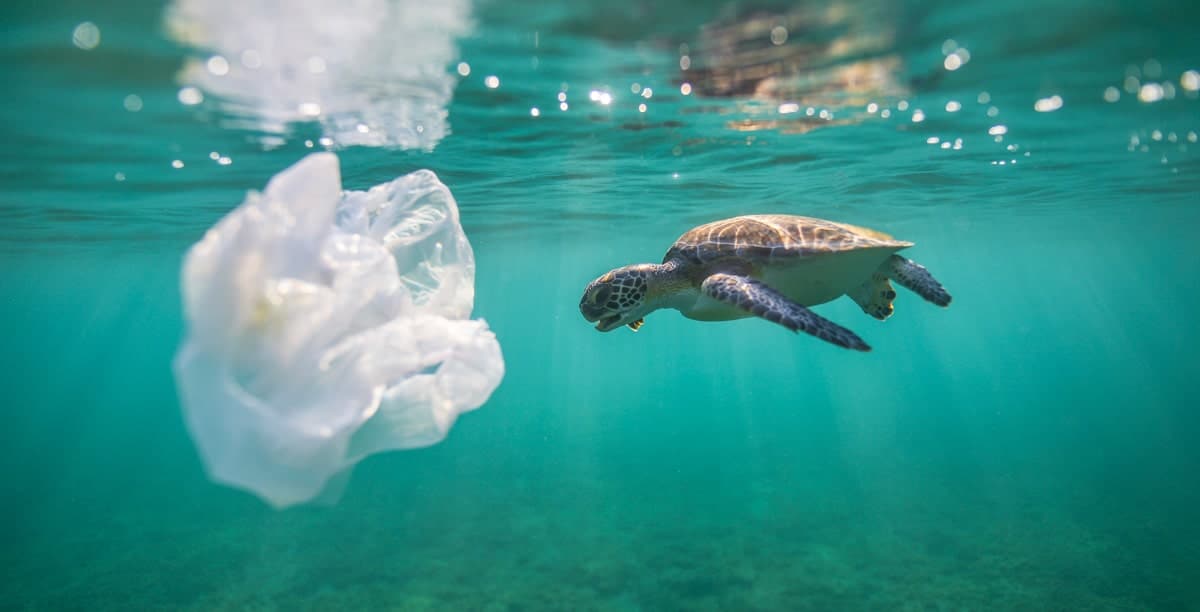
When we asked interviewees how litter affects wildlife, the imagery they shared included harmful effects on distant ecosystems, such as images and videos they had seen of sea turtles with plastic rings around their necks or seagulls ingesting litter on the beach. Respondents rarely mentioned the local wildlife such as birds, mammals, and aquatic life that live in and downstream from the shopping center.
“I think of plastic rings on a seal or penguin. The ocean debris. But out here — nothing comes to mind.”
“I haven’t seen animals in the parking lot being affected by litter.”
However, our research shows a different story: plastics block digestive tracts, alter behavior, and leach into bloodstreams. Microplastics travel up the food chain and return to fish-eating humans (Alberghini et al., 2022). And in the immediate study area, the drainage system at Capital Crossing flows into a pond where we observe stray cats, birds, and other local wildlife drinking, hunting, and living. The harm is not somewhere else. It is right here.
This finding connects to a well-established line of behavioral research on psychological distance, which states that people rarely act on environmental harms that feel spatially, temporally, or socially far away (Maiella et al., 2020). Hence why the “ocean turtle” frame – a psychologically and geographically distant frame – lands less than a physically local frame, such as a kitten drinking from the drainage water two blocks away. When we frame environmental threats as immediate and concrete, people’s propensity for pro-environmental behavior increases significantly.
Recommendation: Education campaigns should feature local wildlife in local drainage systems, not stock images of distant marine life. For example, a parking-lot sign could show a bird eating trash in that extract parking lot with the text “Put your trash in the can, so it can’t become a meal.” The more recognizable the location is within the community, the stronger the behavioral lever.
Below: Sea turtles often mistake plastic bags for prey and ingest them — the kind of distant image interviewees consistently recalled. (Photo: Ben J. Hicks)
Below: A kitten drinking water from a body of water downstream from the shopping center — the kind of local impact interviewees rarely mentioned.

Finding #3 — More Than Just an Eyesore
Interviewees underestimated the harm litter causes to bodies and to local wildlife, but they emphasized something else: how a place looks and feels. This theme surfaced in nearly every response, and it turned out to be the most actionable lever we found.
“People see trash and feel that littering another piece isn’t going to change anything.”
“The worse the place looks the crappier it is. It’s the vibes of the place.”
Decades of behavioral research back this intuition. Keizer, Lindenberg, and Steg (2008, 2013) demonstrated in a series of controlled field experiments that disordered environments signal collapsed norms, and once people receive that signal, they are far more likely to break other norms as well. In one study, littering rates doubled in already-littered environments, jumping from 14% to 32%. Schultz et al. (2013) found that visible maintenance, simply the act of sweeping, increased helping behavior from 40% to 82%.
A clean environment does more than look nice. It actively shapes what people do next.
Recommendation: Routine maintenance is itself a behavioral intervention. It signals that proper disposal is the norm and that disorder will not stand. Campaigns like “Keeping Raleigh clean” amount to more than just a slogan: visible upkeep is the behavioral cue that does the work.
Below: An embankment nearby the shopping center showing wind-driven debris litter — the kind of accumulation that signals disorder and invites more littering.

Conclusion — Putting This to Work at a Bus Stop
What connects these three findings is that none of them require new infrastructure. They just require a different kind of messaging. Standard appeals fail not because people lack information; they fail because the information does not resonate. The findings point at the environment instead of the person, at distant places instead of this one, at values someone may not hold. Each recommendation in this study reshapes that message to match how people perceive litter and what motivates them: this affects you, this happens here, this place is cared for.
Suppose you want to tackle cigarette litter at a local bus stop. Here’s what each step looks like in practice.
It affects you. Put up a sign that skips the environment entirely and speaks to the person on the bench. For example: “What’s on the ground ends up in you, in the water, in the food, in the body.” The appeal points at a stake they already have, not a value they might not.
It happens here. Pair the sign with an image of local wildlife from the drainage system near the sign, the bird or the stray cat at the pond downstream, not a distant sea turtle. For example: a photo with the line “This drains to where they live, three blocks from this bench.” The more recognizable the place, the stronger the impact.
This place is cared for. Keep the stop visibly maintained. Empty the receptacle before it overflows, sweep the embankment, and clear litter on a regular cycle. The upkeep itself carries the message: disposal is the norm here, and litter is not welcomed.
Then measure it. A single bus stop is the ideal place to test all three interventions, because the footprint is small, the audience repeats daily, and the before-and-after is countable with the same grid collection this study used. Build the intervention at one stop, count what changes, and you have evidence before you scale it across the street.
Where I’m Going Next
This project showed me that effective environmental management depends as much on understanding people as it does on understanding ecosystems. Collecting litter revealed what accumulated on the ground, while interviewing community members revealed why it accumulated in the first place.
I plan to carry that approach into a career in environmental management and restoration. The skills this project sharpened – framing a research question, reviewing literature, building a data collection protocol, running intercept interviews, and translating findings into practical recommendations – all point toward the same goal of connecting scientific research with the communities it serves.
Environmental restoration and management move fastest when practitioners directly engage with stakeholders, direct funding toward effective interventions that match how people actually behave, and measure results honestly. Whether the next project is a watershed restoration plan, a coastal resilience initiative, or another litter study in a different community, I want to keep pairing rigorous field data with real conversations, and turning both into decisions someone can act on.
You can reach me on LinkedIn: https://www.linkedin.com/in/samantha-foresman-368272277/.
Below: Samantha Foresman — professional headshot.

References
Alberghini, L., Truant, A., Santonicola, S., Colavita, G., & Giaccone, V. (2022). Microplastics in Fish and Fishery Products and Risks for Human Health: A Review. International Journal of Environmental Research and Public Health, 20(1), 789. https://doi.org/10.3390/ijerph20010789
De Souza, L. L. F., Victor, C., Dumont, J. J. R., & Maia, L. M. (2023). Organic cosmetics and the use of emotional appeals. Revista de Administração Contemporânea, 27(3), e220089. https://doi.org/10.1590/1982-7849rac2023220089.en
Doll, B., Kurki-Fox, J., & Putnum, G. (2023, June 20). A River of Plastics. Coastwatch; Sea Grant. https://ncseagrant.ncsu.edu/coastwatch/river-of-plastics/
Duke Health. (2023, November 17). Nanoplastics Promote Conditions for Parkinson’s Across Various Lab Models. https://corporate.dukehealth.org/news/nanoplastics-promote-conditions-parkinsons-across-various-lab-models
Keep America Beautiful. Keep America Beautiful 2026 National Litter Study Summary Report.
Keizer, K., Lindenberg, S., & Steg, L. (2008). The Spreading of Disorder. Science, 322(5908), 1681–1685. https://doi.org/10.1126/science.1161405
Keizer, K., Lindenberg, S., & Steg, L. (2013). The Importance of Demonstratively Restoring Order. PLoS ONE, 8(6), e65137. https://doi.org/10.1371/journal.pone.0065137
Keller, E., Marsh, J. E., Richardson, B. H., & Ball, L. J. (2022). A systematic review of the psychological distance of climate change: Towards the development of an evidence-based construct. Journal of Environmental Psychology, 81. https://doi.org/10.1016/j.jenvp.2022.101822
Klöckner, C. A. (2015). The psychology of pro-environmental communication: Beyond standard information strategies. London: Palgrave Macmillan.
Maiella, R., La Malva, P., Marchetti, D., Pomarico, E., Di Crosta, A., Palumbo, R., Cetara, L., Di Domenico, A., & Verrocchio, M. C. (2020). The Psychological Distance and Climate Change: A Systematic Review on the Mitigation and Adaptation Behaviors. Frontiers in Psychology, 11, 568899. https://doi.org/10.3389/fpsyg.2020.568899
Mohd Fazal Ur Rehman, Mohammad Muaz Khan, Mohammad Mansoob Khan. (2025). Impact of microplastics and nanoplastics on human health: Mechanistic insights and exposure pathways. Toxicology Letters, Volume 414, 111769, ISSN 0378-4274, https://doi.org/10.1016/j.toxlet.2025.111769
Schultz, P. W., Bator, R. J., Large, L. B., Bruni, C. M., & Tabanico, J. J. (2013). Littering in Context: Personal and Environmental Predictors of Littering Behavior. Environment and Behavior, 45(1), 35–59. https://doi.org/10.1177/0013916511412179
Sofield, C. E., Anderton, R. S., & Gorecki, A. M. (2024). Mind over Microplastics: Exploring Microplastic-Induced Gut Disruption and Gut-Brain-Axis Consequences. Current Issues in Molecular Biology, 46(5), 4186–4202. https://doi.org/10.3390/cimb46050256
Tong, Z., & Sun, Y. (2022). Editorial: Achieving Well-Being-Bridging Psychological Distance in Our Environment. Frontiers in psychology, 13, 813341. https://doi.org/10.3389/fpsyg.2022.813341